
Independent NDC12 resource · Not affiliated with the FDA

Regulatory facts linked to current FDA sources  View FDA source

THE FDA'S 12-DIGIT NATIONAL DRUG CODE

What Is NDC12? The FDA’s 12-Digit National Drug Code Explained

NDC12 is the FDA’s uniform 12-digit National Drug Code format. It uses a 6-4-2 structure and takes effect on March 7, 2033.
NEW FDA FORMAT
12 Digits
UNIFORM STRUCTURE
6-4-2
RULE EFFECTIVE
March 7, 2033
LABEL TRANSITION ENDS
March 6, 2036
Complete NDC12 Guide

Everything You Need to Know About NDC12

Explore the key parts of the NDC12 transition, including the new 6-4-2 format, implementation dates, affected organizations, system changes, label and barcode requirements, conversion rules, and readiness steps. Select any topic below to view the full explanation.
01

The National Drug Code, commonly called the NDC, is an FDA standard used to identify listed drugs marketed in the United States.

An NDC contains three distinct parts:

  • Labeler code: identifies the manufacturer, repackager, relabeler, private-label distributor, or other organization associated with the drug listing.
  • Product code: identifies a specific strength, dosage form, and formulation for that labeler.
  • Package code: identifies the package size and type.

The three-part structure remains under NDC12. What changes is the number of digits assigned to each segment and the use of one consistent format.

02

FDA is moving to a 12-digit format because the available supply of five-digit labeler codes is limited and the current system uses multiple native configurations: 4-4-2, 5-3-2 and 5-4-1.

The final rule creates one consistent 6-4-2 structure for FDA-assigned NDCs, reducing the need for format conversion and expanding the available pool of labeler and product codes.

The transition is more than the addition of two digits. It can affect labeling, databases, integrations, validation rules, barcodes, reports, files, and trading-partner exchanges.
03

Every standard NDC12 will contain 12 digits divided into three fixed segments. The standard human-readable format is XXXXXX-XXXX-XX.

000000
Labeler · 6
0000
Product · 4
00
Package · 2

Segment

Length

Purpose

Labeler code

6 digits

Identifies the organization associated with the drug listing

Product code

4 digits

Identifies the strength, dosage form, and formulation

Package code

2 digits

Identifies the package size and type

The new structure removes the need to determine which native segment configuration is being used before interpreting the NDC.

04

NDC10, NDC11, and NDC12 are related, but they should not be treated as interchangeable terms.

Format

Main use

Typical structure

Key clarification

NDC10

Current FDA-assigned drug identifier

4-4-2, 5-3-2, or 5-4-1

FDA continues assigning current-format NDCs before March 7, 2033

NDC11

Currently used in HIPAA reimbursement transactions

5-4-2

A standardized representation created by adding a leading zero to the appropriate NDC10 segment

NDC12

Future FDA-assigned drug identifier

6-4-2

The uniform FDA format effective March 7, 2033

Does NDC12 replace NDC11?

The FDA final rule does not itself amend the HIPAA transaction standards that currently use an 11-digit, 5-4-2 NDC representation for reimbursement.

FDA’s rule applies to NDCs assigned by FDA. HIPAA transaction standards are governed separately. FDA has stated that it expects the current HIPAA standard to be updated before the NDC12 effective date so it can accommodate the new 12-digit format.

For current planning purposes, teams should therefore distinguish between:

  • The native FDA-assigned NDC.
  • The format used in specific reimbursement or healthcare transactions.
  • Any future updates issued by the agencies responsible for HIPAA standards.

Do not assume that adding a zero to create NDC11 and converting an FDA-assigned code to NDC12 are the same process.

05

The NDC12 final rule takes effect on March 7, 2033.

FDA provided a seven-year preparation period after publication of the final rule so affected organizations can update their systems, processes, infrastructure, and labeling.

March 5, 2026 through March 6, 2033: Preparation period

During this period:

  • FDA continues assigning NDCs in the current formats.
  • Organizations should identify every system and workflow that uses an NDC.
  • Manufacturers and labelers should prepare updated labeling.
  • Software and data vendors should plan and test required product changes.
  • Trading partners should define their format, testing, and cutover expectations.

March 7, 2033: Effective date

On the effective date:

  • FDA begins assigning new NDCs in the uniform 12-digit format.
  • Existing FDA-assigned 10-digit NDCs are converted to the 12-digit format.
  • Affected systems should be capable of processing the new structure.

March 7, 2033 through March 6, 2036: Drug-labeling transition

FDA has provided a three-year period to complete label updates and use remaining stock carrying 10-digit NDCs.

During this period:

  • FDA does not intend to object to the continued use of 10-digit NDCs on existing drug labels.
  • Companies should begin applying 12-digit NDCs to updated labeling as soon as possible.
  • Affected systems should be able to process both 10-digit and 12-digit NDCs.

After the transition

FDA states that drugs labeled with a 10-digit NDC after March 7, 2036 may be subject to regulatory action.

06

NDC12 affects organizations that assign, store, exchange, display, print, scan, validate, report, or otherwise process FDA-assigned NDCs.

Pharmaceutical manufacturers

Review drug-listing data, product labeling, artwork, barcode content, master data and manufacturing/packaging systems.

Wholesale distributors

Review product masters, ordering, receiving, warehouse systems, inventory, scanning and partner interfaces.

Pharmacies and providers

Review product setup, purchasing, dispensing, inventory, claims, EHRs, reporting and scanning.

Payors and reimbursement teams

Distinguish the new FDA-assigned format from reimbursement transaction standards as related standards evolve.

Software and data vendors

Review field lengths, validation, data models, interfaces, APIs, exports, reports, crosswalks and product roadmaps.

07

NDC12 should be treated as a cross-functional data and operational change, not only as a labeling project.

Systems and applications
Identify systems that store, validate, display, print, calculate with, or exchange NDCs.

Data models and validation
Review field lengths, data types, leading-zero preservation, segment validation, hyphen placement, APIs, transformation rules, duplicate detection, matching logic and historical records.

Integrations and external files
Review APIs, flat files, EDI, spreadsheets, reports, data feeds, regulatory submissions, vendor files and partner portals.

Vendors and testing
Confirm roadmaps, release dates, dual-format capability, configuration, testing availability, interface changes and external dependencies.

These are practical implementation considerations and should not be presented as individual FDA requirements unless supported directly by FDA guidance.
08

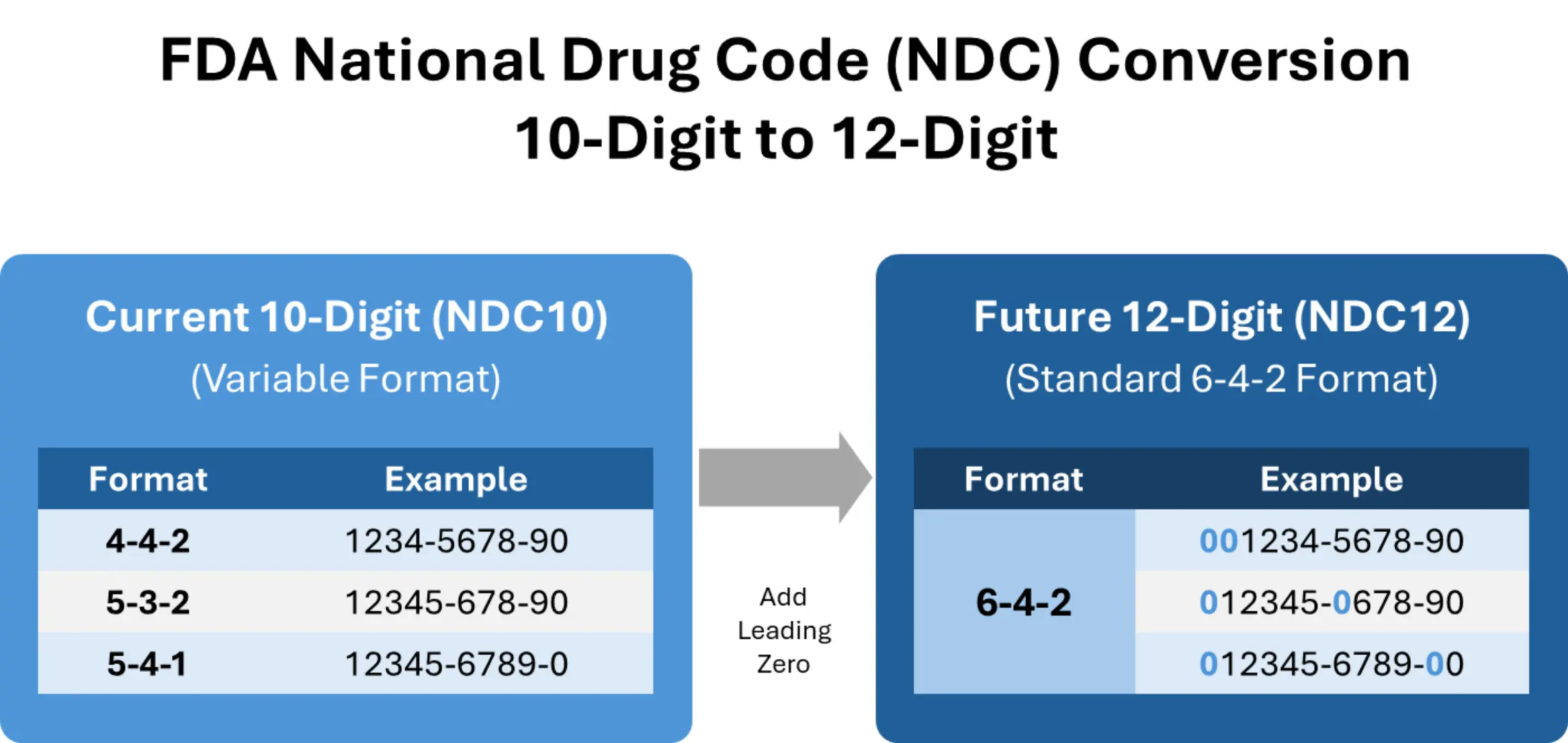
On March 7, 2033, FDA will convert existing FDA-assigned 10-digit NDCs to the uniform 12-digit, 6-4-2 format.

The conversion will add leading zeros to the labeler, product, or package segment as necessary.

Illustrative conversion examples

These examples are fictional and are provided only to demonstrate the format.

Current format

Illustrative NDC10

Converted NDC12

4-4-2

1234-5678-90

001234-5678-90

5-3-2

12345-678-90

012345-0678-90

5-4-1

12345-6789-0

012345-6789-00

The segment boundaries matter. A conversion process should not simply add two zeros to an unstructured ten-digit string.

FDA does not consider the addition of leading zeros for this format conversion, by itself, to be the assignment of a completely new NDC.

Organizations should nevertheless verify how converted identifiers will be represented across source systems, interfaces, labels, reports, and external partner files.

09

Companies should use the preparation period to ensure that revised labeling is ready when the rule becomes effective.

The three-year labeling transition begins on March 7, 2033 and continues through March 6, 2036.

During this period:

  • FDA does not intend to object to continued use of 10-digit NDCs on existing labeling.
  • Companies should begin replacing 10-digit NDCs with 12-digit NDCs as soon as possible.
  • Old labeling stock can be depleted during the transition.
  • Systems should support products carrying either format.

Labeling teams should assess:

  • Cartons.
  • Containers.
  • Package inserts where applicable.
  • Artwork templates.
  • Labeling software.
  • Approval workflows.
  • Printer capabilities.
  • Barcode placement.
  • Space requirements.
  • Inventory of existing label stock.

The phrase “10-digit NDC expiration” can oversimplify this transition. The more accurate approach is to refer to the confirmed effective date and the three-year labeling period.

10

The final rule permits linear or nonlinear barcodes when they conform to an FDA-recognized standard developed by a widely recognized international standards organization.

For products subject to DSCSA product-identifier requirements, a two-dimensional data matrix can encode the 12-digit NDC using GS1 Application Identifier 715 and may also contain serial number, lot number, and expiration date.

11

FDA plans to automatically update drug-listing files to reflect the 12-digit format on March 7, 2033.

Registrants will not need to submit a new or updated drug-listing file solely because FDA converted the NDC format.

Registrants are expected to update their drug-listing files when the corresponding product labeling is updated to include the 12-digit NDC.

Organizations should still review how the FDA update will affect:

  • Internal listing records.
  • Regulatory-information systems.
  • Product masters.
  • Data feeds.
  • Partner files.
  • Reconciliation processes.
12

Certain specified human cells, tissues, and cellular or tissue-based products may continue to use an alternative NDC format approved by FDA.

This is a limited exception and should not be interpreted as a general exemption from NDC12.
Organizations working with these products should confirm the applicable FDA requirements for their specific product portfolio.

13

The 2033 effective date gives the industry time to prepare, but the work may involve multiple systems, vendors, departments, and external partners.

A practical readiness program should begin with the following steps.

1. Establish ownership

Assign an executive sponsor, program owner, and cross-functional team.

The team may include:

  • Regulatory.
  • Quality.
  • Information technology.
  • Master data.
  • Labeling.
  • Packaging.
  • Supply chain.
  • Finance and reimbursement.
  • Legal or compliance.
  • Vendor management.
  • Project management.

2. Inventory every use of the NDC

Identify where NDCs are:

  • Created.
  • Stored.
  • Displayed.
  • Printed.
  • Scanned.
  • Converted.
  • Validated.
  • Exchanged.
  • Reported.

3. Identify hard-coded assumptions

Look for systems that expect:

  • Exactly ten digits.
  • An 11-digit reimbursement representation.
  • A particular segment length.
  • Fixed hyphen positions.
  • Numeric fields that remove leading zeros.

4. Map integrations and trading partners

Document:

  • The source of each NDC.
  • The format received.
  • The format sent.
  • Transformation logic.
  • File and interface ownership.
  • Partner dependencies.

5. Review labeling and barcode processes

Assess:

  • Labeling inventory.
  • Artwork.
  • Printing.
  • Barcode standards.
  • Scanning.
  • Package configurations.
  • Regulatory workflows.

6. Engage vendors

Request documented NDC12 roadmaps, release plans, testing support, and customer responsibilities.

7. Define transition requirements

Determine how systems will process both 10-digit and 12-digit NDCs during the 2033–2036 labeling transition.

8. Build a testing strategy

Include internal systems, vendors, trading partners, interfaces, labels, scanners, reports, and exception handling.

9. Prioritize high-risk dependencies

High-risk areas may include:

  • Older applications.
  • Custom code.
  • Unmaintained interfaces.
  • Large product masters.
  • Complex partner networks.
  • Systems that strip leading zeros.
  • Labels with limited available space.

10. Create a phased roadmap

Set realistic phases for:

  • Discovery.
  • Impact assessment.
  • Design.
  • Remediation.
  • Vendor delivery.
  • Testing.
  • Label transition.
  • Deployment.
  • Monitoring.
Prepare for NDC12

Start Your NDC12 Readiness Assessment

Identify how NDC12 may affect your systems, data, labeling, workflows, vendors, and trading partners.
Quick Answers

Frequently Asked Questions About NDC12

Concise answers to the most important questions about the format, timeline, scope, and preparation.
NDC12 is the FDA’s uniform 12-digit National Drug Code format. It contains a six-digit labeler code, a four-digit product code, and a two-digit package code. FDA will begin assigning new NDC12 codes and converting existing FDA-assigned NDCs on March 7, 2033.
The final rule takes effect on March 7, 2033. A three-year drug-labeling transition continues through March 6, 2036. During that period, affected systems should be capable of handling products and data containing either 10-digit or 12-digit FDA-assigned NDCs.
The FDA final rule changes FDA-assigned NDCs. It does not itself revise the HIPAA transaction standards that currently use an 11-digit NDC representation for reimbursement. FDA expects those separate standards to be updated before the 2033 effective date.
Organizations that assign, store, exchange, print, display, scan, validate, or process FDA-assigned NDCs should assess their readiness. This may include manufacturers, repackagers, relabelers, distributors, pharmacies, providers, payors, software vendors, government agencies, and other trading partners.
Begin by assigning ownership, inventorying every system and workflow that uses NDCs, identifying field-length and segment assumptions, engaging vendors, mapping trading-partner dependencies, reviewing labels and barcodes, and creating a phased testing and implementation roadmap.